Ap Statistics Review for the Test Ideas Projects
Robert Lochel, Hatboro-Horsham High Schoolhouse

The Advanced Placement Statistics curriculum contains many natural opportunities for students to demonstrate their understanding through projects. In my grade, students complete three major projects during the yr: an "old wives' tale" experimental design project, a casino game design project, and a final comprehensive project subsequently the AP exam in May. Balancing my want to accept students recollect critically and creatively near a research question, while providing some structure to help students accomplish clear assessment targets, isn't ever piece of cake. Here are some suggestions for helping teachers blueprint project-based learning experiences.
… this was a "what if" we could have avoided by clearly defining each stage of the project before collecting data.
Employ everyday opportunities to generate enquiry questions. Students often struggle to develop a research question which is simple enough to report, still circuitous plenty to generate meaningful word. Recently, I observed a pair of students working on an consignment in our figurer lab. Most of the content of the assignment was complete, and the partnership toyed with font and spacing options before submitting. I wondered out loud whether teachers grade assignments differently based on font choice. Would ii assignments with identical content receive different grades if 1 used Times Roman, while another used Comic Sans? This led to a spirited larger-group discussion of how we could carry out such an experiment. Ideas for stats projects abound – in our daily lives, in the news, on the internet. My first proposition is to maintain an idea board of project ideas for students to view as they enter discussion in your classroom. This can be either a physical lath, with ideas written on index cards, or an online sharing board, housed with a Google Doc or Padlet lath.
Provide reflection opportunities throughout the project period. For all projects my classes complete during the year, there is always a "pit cease" assessment half-style through the consignment fourth dimension period. The pit stop asks students to study on the progress of their project – What has been completed? What needs to exist washed? What adaptations or changes have taken place since the original concept? Rarely is a project completed seamlessly, and the pit-stop avoids much last-minute cramming.
Think about the "what-ifs." Before my students begin submitting proposals for their final projection, I warn them that I will probably shoot downwards their first 3 ideas. I'm not a hateful-spirited person by nature, simply I am proficient at playing devil's advocate with my students, and will immediately retrieve of a laundry list of things which could become wrong with a stats project. Students need to think almost their projection beyond a concept, and flesh out all stages before collecting data – How volition the data be collected? What exactly is beingness measured? How will the information exist analyzed? And how does the result provide evidence towards the research question?
A few years ago, an ambitious group tested the effectiveness of Oxy Clean in removing clothing stains. The partnership did a fantastic job with collecting data: identical t-shirts were cutting into smaller squares, stains were applied uniformly to the samples using ketchup and lipstick, and samples assigned randomly to treatments. The cleaned samples were then neatly organized into groups when it occurred to both the partnership and me that we had no defined method for assessing the remaining stains, which varied only slightly from sample to sample. After a few days of brainstorming, we did assemble a method which involved training some volunteers, simply this was a "what if" we could take avoided past conspicuously defining each stage of the project before collecting information.
Utilise peer evaluations. During our unit on Experimental Design, students consider an "old wives tale" and blueprint an experiment which could test the claim. For instance, think "craven soup helps cure a cold" or "haste makes waste material." Students assemble viii-x slides which explain the design of their experiment, and all slides are then shared online on the class website. While the instructor assesses each project, students are given the task of assessing iii projects of their peers, providing feedback through a Google Form which asks evaluators to assess the project on specific descriptors. The peer feedback is and so given back to the pupil teams. Having students evaluate the work of their peers provides additional opportunity for demonstrating understanding of statistical concepts. Peer reviews as well raise the bar for all students, equally students can compare the quality of their submissions against all projects in the class.
Provide opportunity for students to "share out" their findings. The offset fourth dimension I required students to complete a final project in AP Statistics, students shared their findings with a formal presentation in front end of the form. Whereas this allowed students to explain their projects and take ownership in them, I sought a more interactive experience betwixt students and evaluators. Now, all students participate in a year-ending Stats Fair, where invited guests 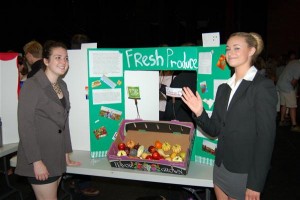 browse projects, speak with students and assess application of statistical concepts. It'southward an exciting fashion to end the year, and you tin see a highlight video from the 2014 version on YouTube (Hatboro-Horsham Stats Off-white). In addition, project and affiche contests from the American Statistical Association also provide opportunity for students to share their piece of work.
Source: https://www.causeweb.org/sbi/?p=578

Post a Comment for "Ap Statistics Review for the Test Ideas Projects"